

Lessons From a Long Fight: The Global Relevance of the Great Lakes Sea Lamprey Control Program
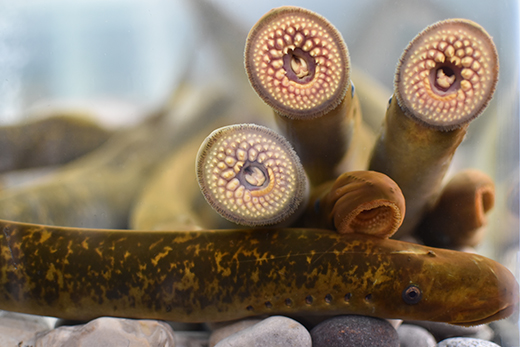
Invasive sea lampreys from the Great Lakes. Credit: Andrea Miehls, Great Lakes Fishery Commission.
Imagine a creature that latches onto a fish with a suction cup mouth ringed with more than 100 teeth and that uses a file-like tongue to rasp through scales and flesh and feed on the fish's blood and body fluids. Now imagine 2.5 million of these parasites swimming throughout the world's largest surface freshwater system, devastating fish populations that millions of people depend on for food and their livelihoods. This was the reality facing the Great Lakes in the mid-twentieth century, when invasive sea lampreys completed their establishment in all five lakes and triggered one of the most dramatic fishery collapses in North American freshwater history.
But what followed was one of the most ambitious, sustained, and ultimately successful invasive species control efforts ever undertaken. Now, more than 75 years after that effort began, a team of scientists and practitioners from universities, Indigenous governments, federal agencies, and the binational Great Lakes Fishery Commission ("Commission") has distilled the hard-won lessons of the sea lamprey control program into a paper published in the journal BioScience: "Ten lessons for controlling invasive species: Wisdom from the long-standing sea lamprey control program on the Laurentian Great Lakes."
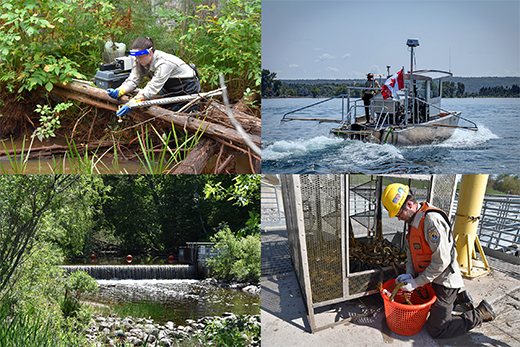
The Great Lakes sea lamprey control program relies on a suite of integrated methods, including the application of the lampricides TFM (top left photo) and Bayluscide (top right) that target the larval stage of sea lampreys, barriers (bottom left) that block adult sea lampreys during spawning migrations, and traps (bottom right) that capture adult sea lampreys for program assessment and research. Credits: (top right) Zak Allan, Great Lakes Fishery Commission; (all others) Andrea Miehls, Great Lakes Fishery Commission.
A Crisis That Sparked Cooperation
Sea lampreys are native to the Atlantic Ocean and its tributaries. They entered the Great Lakes through shipping canals in the mid-1800s and early 1900s, and by 1938 had spread through all five lakes. Unlike in their native range, where sea lampreys are considered a beneficial species, invasive sea lampreys in the Great Lakes are a menace, with swift and severe consequences. Populations of lake trout, a keystone predator that supported Indigenous and commercial fisheries for generations, collapsed under the combined pressure of ongoing overfishing and intense parasitism by sea lampreys. Other native fish, such as lake whitefish, burbot, walleye, and cisco, experienced dramatic declines. Fishing communities and Indigenous nations watched their livelihoods, food security, and traditions unravel.
The crisis ultimately created the political will to do something unprecedented: the United States and Canada signed a treaty in 1954 establishing the Great Lakes Fishery Commission. The Commission was mandated to develop control methods for invasive sea lampreys along with coordinating fisheries research and facilitating cooperative fishery management among the state, provincial, tribal, and federal agencies of the region. Since then, the Commission and its partners have fulfilled this mandate with a moonshot spirit that has yielded considerable success.
This origin story is itself the first lesson in the paper: act boldly in times of crisis. The remaining nine lessons — learned from a collective 275-plus years of experience in sea lamprey research and control shared by the authors of the paper — are to maintain the social license, invest in capacity building, break down the silos, support fundamental science, diversify your portfolio of control measures, strive for continuous improvement, confront the trade-off between information and action, keep your foot on the gas, and keep your eyes on the prize. These lessons from sea lamprey control, though rooted in the Great Lakes, offer insights that resonate well beyond the shores of these vast systems.
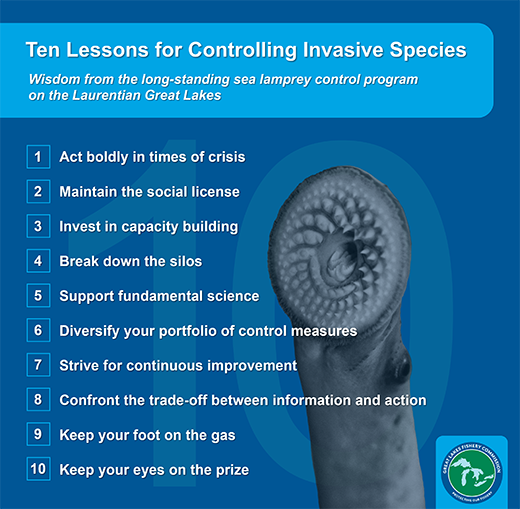
Ten lessons for controlling invasive species learned from more than seven decades of experience controlling invasive sea lampreys in the Great Lakes.
Ten Lessons from a Great Lakes Success Story
The long-term suppression of sea lampreys in the Great Lakes did not arise from a single breakthrough, but rather an iterative process of research, management, and monitoring. Over decades of innovation, trial, collaboration, and persistence, the sea lamprey control program built a body of practical wisdom. The ten lessons below synthesize that knowledge, translating a complex history into guidance applicable to invasive species programs worldwide.
Act boldly in times of crisis. The urgency of catastrophe is a powerful force: unintended crisis can result in unity to take decisive, lasting action. In the early stages of a species invasion, now is the time to act, before the invader establishes and ever reaches the point where ongoing control is necessary.
Maintain the social license. Keeping policymakers, stakeholders, rightsholders, and the public genuinely informed about why control efforts matter – and actively listening to their concerns – is just as essential as the underlying science and management.
Invest in capacity building. Enhancing the skills of individuals, organizations, and communities; training the next generation of scientists, control program staff, and communicators; and actively diversifying who enters the field, strengthens a program’s ability to solve problems and sustain itself across decades.
Break down the silos. When scientists, control program staff, communicators, and decision makers work in the same rooms, sit on the same committees, and share the same goals, science bridges the “knowledge-action gap” – moving from the “lab to the lake” – far faster.
Support fundamental science. Curiosity-driven research with seemingly few connections to the practical problems of today, such as studying sea lamprey genomics, sensory behavior, and physiology, can become the foundation for tomorrow’s most powerful control tools. Fundamental science is a worthwhile investment that can pay dividends in the future.
Diversify your portfolio of control measures. Relying on a single control tool is a vulnerability; an integrated program that combines, for instance, lampricides, barriers, traps, and emerging techniques, is far more resilient and adaptable to changes in the environment as well as societal context.
Strive for continuous improvement. Treating every setback, surprise, and success as a learning opportunity, as opposed to a failure or endpoint, allows a control program to improve over decades rather than stagnate. Fostering trust among key players through long-term collaboration opens the space to making decisions in the face of uncertainty, maintaining flexibility, and continual refinement.
Confront the trade-off between information and action. With limited resources, a balance must be struck between gathering data and taking action. In some cases, ideal data are not worth the cost: a reminder that for invasive species control, the perfect can be the enemy of the good.
Keep your foot on the gas. Reductions in sea lamprey control during the COVID-19 pandemic showed starkly that even a single year of reduced effort can unleash a surge of sea lampreys resulting in substantial mortality of fish. Invasive species control cannot afford a pause.
Keep your eyes on the prize. Controlling invasive species matters, but the real aim (ultimate goal) is often the maintenance of healthy, thriving populations of native or beneficial species, and the numerous benefits they provide to society. This recognition keeps every action meaningful and every dollar justified.
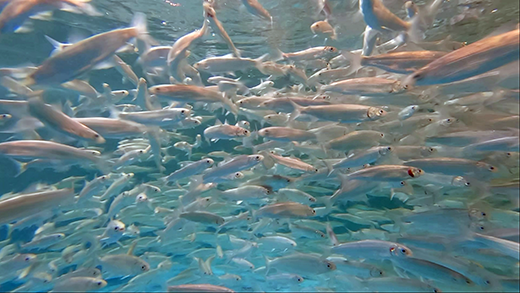
Young cisco school together in a tank as part of a Great Lakes restoration program. Ciscoes once supported one of the largest fisheries in the Great Lakes until overfishing and invasive species caused dramatic collapses in their populations. Sea lamprey control protects economically valuable fisheries in the Great Lakes and paves the way for many restoration programs. Credit: Andrea Miehls, Great Lakes Fishery Commission.
Wisdom for a World Under Invasion
Invasive species are among the leading drivers of biodiversity loss worldwide, and the problem is growing each year. The annual economic costs of biological invasions globally run into the hundreds of billions of dollars.
The lessons from sea lamprey control are intended to serve as ideas, inspiration, and candid advice (based on successes and failures) for others working on the control of biological invasions. The lessons are not unique to sea lampreys or to freshwater ecosystems. They apply to cane toads in Australia, brown tree snakes in Guam, invasive beetles in Europe, and countless other biological invasions around the world.
Controlling invasive species is not a problem you solve once and walk away from. Maintenance of healthy ecosystems is a commitment measured in generations, requiring sustained funding, sustained science, and sustained public will. The Great Lakes sea lamprey control program – and similar programs around the world – endure because the people and institutions involved understand that natural resources, and the communities that depend on them, are worth protecting.
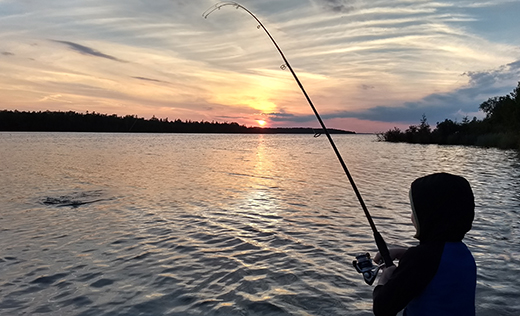
Sea lamprey control safeguards Great Lakes fisheries valued over $5 billion annually and protects the timeless tradition of fishing, shared by more than a million people each year. Credit: Nick Johnson, with permission.
The paper, "Ten lessons for controlling invasive species: Wisdom from the long-standing sea lamprey control program on the Laurentian Great Lakes,"" is published in BioScience (Volume 75, Issue 11, November 2025; https://doi.org/10.1093/biosci/biaf133). Steven Cooke, Carrie Baker, Julia Mida Hinderer, Michael Siefkes, Jessica Barber, Todd (Michael) Steeves, Margaret Docker, Weiming Li, Michael Wilkie, Michael Jones, Kelly Robinson, Erin Dunlop, Cory Brant, Nicholas Johnson, William Mattes, Marc Gaden, and Andrew Muir authored the original paper.
Read more Pulse on Science: Project Spotlights
- 4-H Campers Dive into the Invasive Species Challenge Facing the Great Lakes
- Lessons From a Long Fight: The Global Relevance of the Great Lakes Sea Lamprey Control Program
- New Trap for Stopping an Old Predator on the North Shore of Lake Superior
- New Study Concludes Invasive Sea Lampreys Can Be Controlled by the Release of Sterilized Males
- Happy 75th anniversary to Hammond Bay Biological Station!
- Great Lakes Habitat Restoration: Partnering to Promote Fish Production
- Sea Lamprey Control Spreads the Distance
- Making the Best of a Bad Situation: Great Lakes Sea Lampreys Reveal the Origins of Vertebrate Traits
- Studying the Fish of Buffalo Reef, Traverse Bay, Lake Superior
- Doing Science is Essential...Communicating Science is Just as Critical (and maybe more FUN!)
- Faithful Fish: Walleye Show High Spawning Site Fidelity in the Great Lakes
- Finding the Sea Lamprey's Kryptonite
- Good Things Come in...Polymer Packages?
- Rambunctious Reproduction Overheard Among Great Lakes' Lake Trout
- Clearer Water Means Less Fish: Understanding How Lower Trophic Level Changes Impact Lake Huron's Fisheries