

New Trap for Stopping an Old Predator on the North Shore of Lake Superior
Written by Lauren Holbrook, Great Lakes Fishery Commission and Andrea Miehls, Great Lakes Fishery Commission.
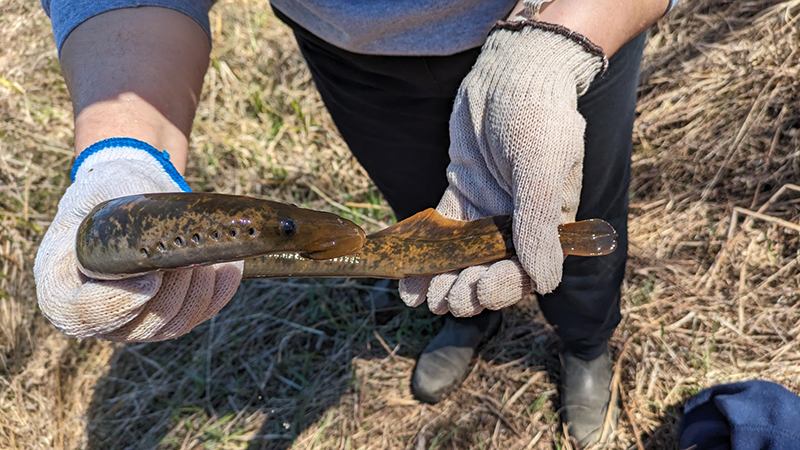
An invasive, parasitic sea lamprey caught in the new Neebing River sea lamprey trap.
Credit: Lakehead Region Conservation Authority.
There’s a new sea lamprey trap in Ontario! The trap is located approximately 5 km upstream from the mouth of the Neebing River in Thunder Bay. Since construction completed in the spring of 2025, the trap has been capturing adult sea lampreys migrating upstream to spawn, removing this noxious invasive species from the river and also assisting the Great Lakes Fishery Commission and partners to assess the success of sea lamprey control efforts in Lake Superior.
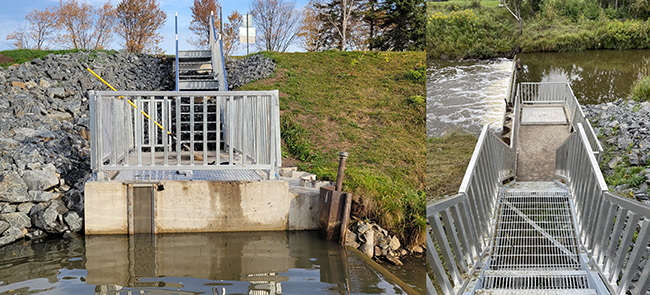
Two views of the new Neebing River sea lamprey trap, a permanent structure located in Thunder Bay, Ontario. The trap is located beneath the metal cover visible at the end of the walkway in the photo on the right. Credits: (left) Ryan Booth, Fisheries and Oceans Canada; (right) Lauren Holbrook, Great Lakes Fishery Commission.
Sea lampreys are parasitic fish native to the Atlantic Ocean that feed by latching onto other fish and draining blood and bodily fluids. While not a concern in their native habitat, a single sea lamprey is capable of killing up to 40 pounds (18 kilograms) of Great Lakes fish during its 12-18 month parasitic phase. Sea lampreys were first observed in Lake Superior in 1938, and since then have caused considerable harm—contributing to the collapse of Great Lakes fisheries in the 1940s and 1950s, which drastically altered the region’s ecology and economy.
The Great Lakes Fishery Commission, formed through a 1954 treaty between Canada and the United States, partners with Fisheries and Oceans Canada (DFO) and the U.S. Fish and Wildlife Service to implement the Sea Lamprey Control Program (SLCP). The program uses an integrated approach of lampricides and barriers to control sea lampreys, and trapping of spawning sea lampreys to assess control efforts. The program has reduced sea lamprey populations by 90% in most areas of the Great Lakes, helping to sustain multibillion-dollar fisheries.
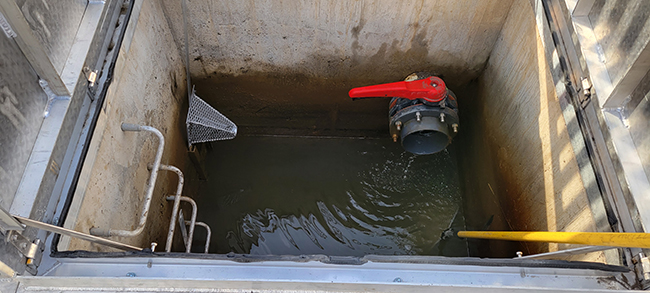
A view inside the new Neebing River sea lamprey trap. The metal cone on the left side is a one-way entrance for sea lampreys. The valve and pipe on the top-right allows water to flow through the trap to attract sea lampreys. Credit: Ryan Booth, Fisheries and Oceans Canada.
What makes the new Neebing River sea lamprey trap so critical to the program? The trap serves as the only Canadian "index site" (i.e., location where adult sea lampreys are counted) on Lake Superior. Years of experience trapping and counting adult sea lampreys on nearly 70 streams throughout the Great Lakes has shown that a handful of streams on each Great Lake provides an accurate depiction of lake-wide population sizes through time. To save valuable program dollars, which in turn can be diverted to the cost of controlling sea lampreys, the SLCP now only counts adult sea lampreys on 5-7 streams—the “index sites”—on each Great Lake. Lake Superior has seven index sites in total.
Previously, temporary, portable traps were used that posed logistical challenges to DFO and staff from the Lakehead Region Conservation Authority (LRCA) that collect sea lamprey data at this site each spring. The new, permanent structure will reduce maintenance challenges and improve the efficiency of long-term monitoring, helping inform our knowledge of the status of sea lamprey populations—and consequently the success of sea lamprey control—in Lake Superior and across the Great Lakes basin!
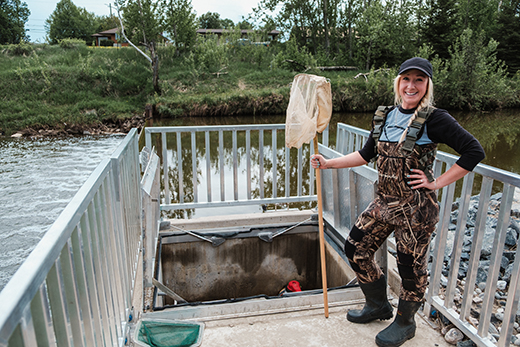
Michelle Willows, from the Lakehead Region Conservation Authority (LRCA), checks the Neebing River sea lamprey trap.
Credit: LRCA.
To celebrate the installation of this critical sea lamprey trap and raise community awareness, a dedication ceremony organized by the LRCA, DFO, and Great Lakes Fishery Commission was held on September 11, 2025. The event included remarks from each of the three organizations, supportive comments from local and regional authorities, and the unveiling of a new sign about the trap.
The new Neebing River sea lamprey trap strengthens a decades-long, multi-national commitment to combating one of the region’s most destructive invasive species. With continued collaboration among partners and support from local communities, the Neebing River trap will help sustain healthy fisheries and safeguard this invaluable resource for generations to come.
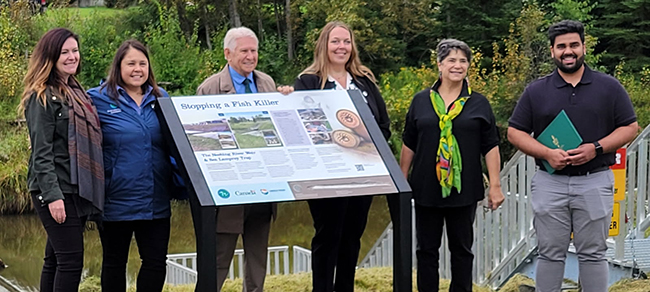
Unveiling of the new Neebing River sea lamprey trap sign following a dedication ceremony in Thunder Bay, Ontario. Pictured (left-to-right) are: Tonia Van Kempen, Fisheries and Oceans Canada; Lauren Holbrook, Great Lakes Fishery Commission; Ken Boshcoff, Mayor of Thunder Bay, Ontario; Tammy Cook, Lakehead Region Conservation Authority; Lise Vaugeois, MPP, Thunder Bay-Superior North; Kushal Satra, representative for Patty Hajdu, MP, Thunder Bay-Superior North. Credit: Ryan Booth, Fisheries and Oceans Canada.
Read more Pulse on Science: Project Spotlights
- 4-H Campers Dive into the Invasive Species Challenge Facing the Great Lakes
- Lessons From a Long Fight: The Global Relevance of the Great Lakes Sea Lamprey Control Program
- New Trap for Stopping an Old Predator on the North Shore of Lake Superior
- New Study Concludes Invasive Sea Lampreys Can Be Controlled by the Release of Sterilized Males
- Happy 75th anniversary to Hammond Bay Biological Station!
- Great Lakes Habitat Restoration: Partnering to Promote Fish Production
- Sea Lamprey Control Spreads the Distance
- Making the Best of a Bad Situation: Great Lakes Sea Lampreys Reveal the Origins of Vertebrate Traits
- Studying the Fish of Buffalo Reef, Traverse Bay, Lake Superior
- Doing Science is Essential...Communicating Science is Just as Critical (and maybe more FUN!)
- Faithful Fish: Walleye Show High Spawning Site Fidelity in the Great Lakes
- Finding the Sea Lamprey's Kryptonite
- Good Things Come in...Polymer Packages?
- Rambunctious Reproduction Overheard Among Great Lakes' Lake Trout
- Clearer Water Means Less Fish: Understanding How Lower Trophic Level Changes Impact Lake Huron's Fisheries